
The Permanent Frontier: Pegasus and the Architecture of the Elite Western Ecosystem
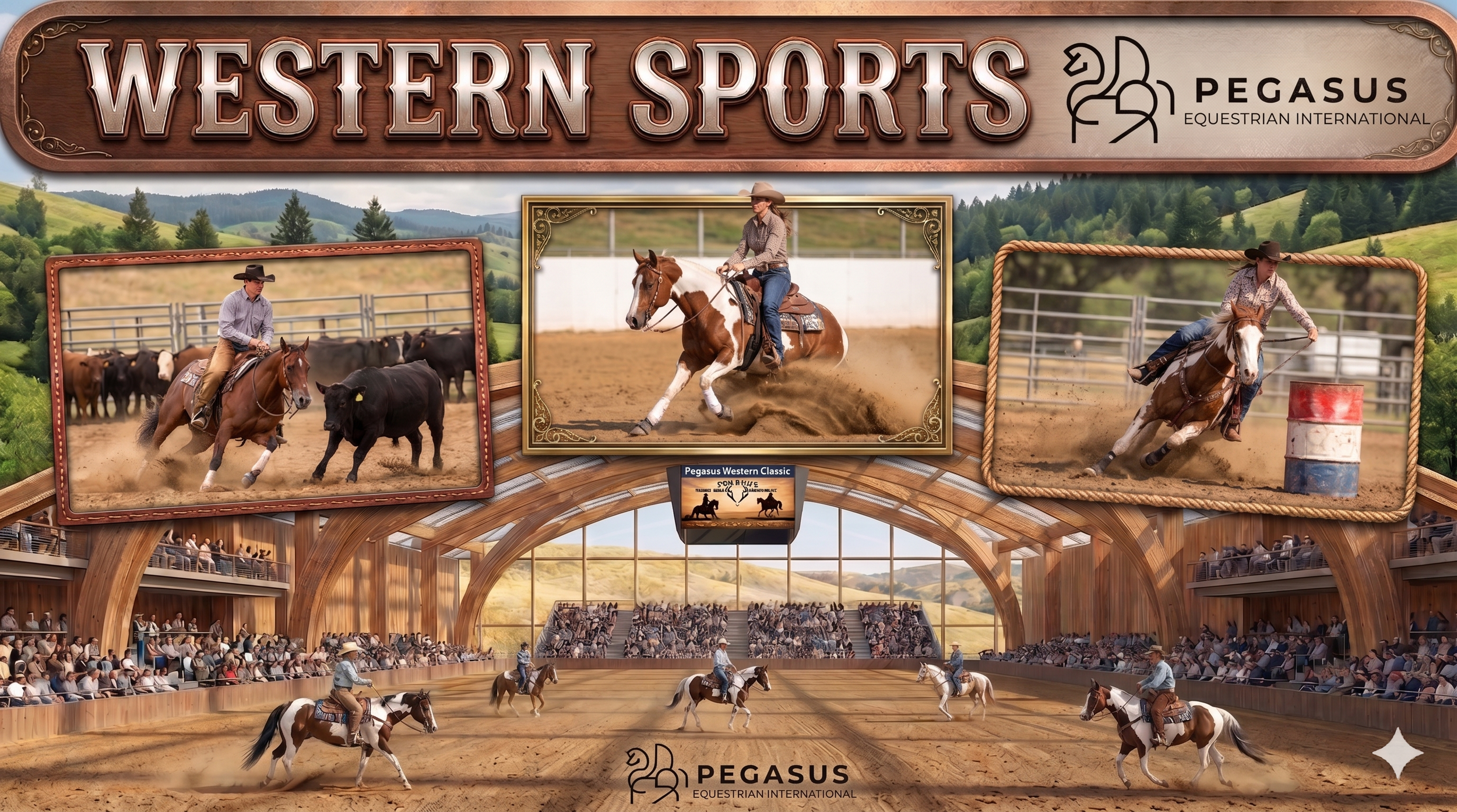
Western Sports at Pegasus (Pegasus Equestrian International / Gemini 2026)
Also posted on LinkedIn Here.
The Western equestrian industry currently exists in a state of precarious paradox. While the cultural footprint and economic impact of Western sports have never been more robust, the physical infrastructure supporting them is in a state of terminal decline. For decades, the "Big 10" organizations—the pillars of performance like the National Cutting Horse Association (NCHA), the National Reined Cow Horse Association (NRCHA), and the Professional Rodeo Cowboys Association (PRCA)—have been forced into an era of compromise. They serve as temporary guests in aging, land-locked urban fairgrounds that were designed for a mid-century version of agriculture, not the high-stakes, high-performance reality of the 21st century. These legacy venues are increasingly suffocated by metropolitan sprawl, leaving the industry to compete with international soccer tournaments and corporate conventions for basic resources like lodging, transport, and air quality.
Pegasus Equestrian International represents the definitive end of this era of compromise. Situated on 3,000 acres in the temperate low hills of Douglas County, Oregon, Pegasus is not merely a venue; it is a visionary ecosystem designed to serve as the permanent sanctuary for the Western spirit. By integrating elite arena competition, professional racing, comprehensive cattle management, and luxury hospitality into a single, protected geography, Pegasus addresses the systemic "Legacy Gap" that threatens the professionalization of the sport. This integration also creates a uniquely valuable platform for sponsors, leveraging the cross-pollination of all equestrian disciplines on site. This report details the specific site-level advantages—from the "Pasture-to-Arena" cattle pipeline to the mass timber "cathedrals" of the Jewel Arena—that position Pegasus as the ultimate destination for the elite Western athlete.
The Economics of the Urban Squeeze: Identifying the Legacy Gap
The modern Western equestrian industry is driven by a small group of high-impact organizations whose flagship events generate hundreds of millions of dollars in economic activity. However, the venues currently hosting these events—primarily in cities like Oklahoma City, Fort Worth, and Columbus—are facing an existential crisis. Urbanization has surrounded these fairgrounds, preventing expansion and driving up the cost of participation. When the All American Quarter Horse Congress descends on Columbus, Ohio, exhibitors are forced into a "room competition" with every other major event in the city, leading to price gouging and a lack of affordable housing for the essential backstretch personnel.
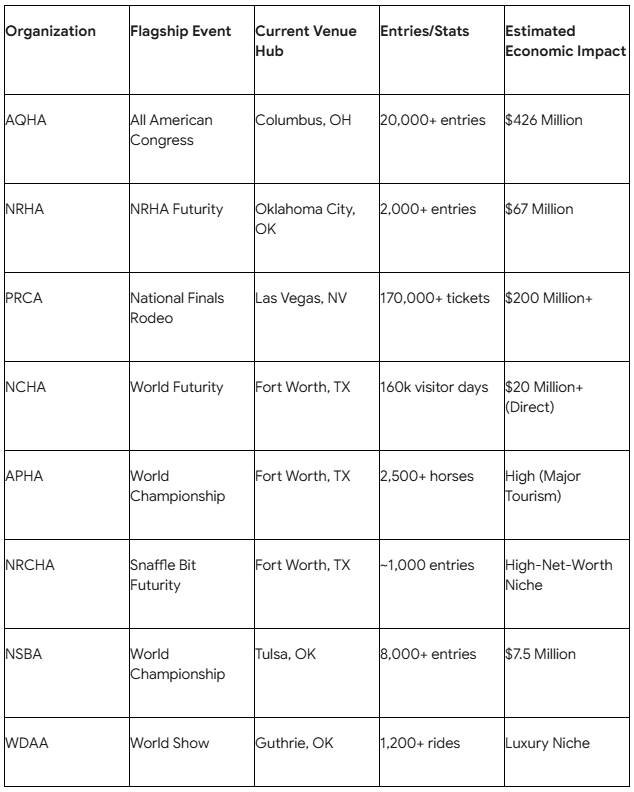
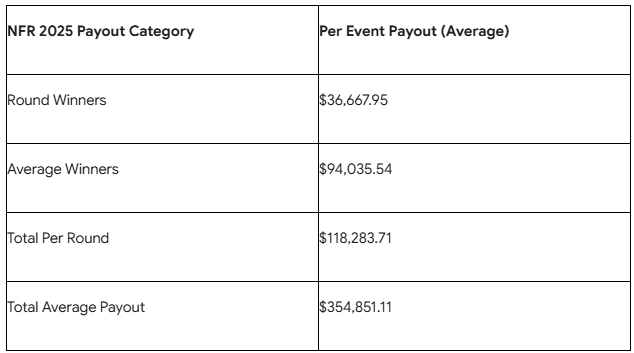
The economic friction of the urban model is most visible during the National Finals Rodeo (NFR) in Las Vegas. While the payout has reached historic levels—with average winners taking home over $94,000 per event in 2024—the cost of "being in the room" continues to escalate. [4]
[4]
In contrast, Pegasus eliminates this friction through vertical integration. Because Pegasus controls the on-site lodging, retail, and food services, it ensures that participants are never in competition with outside events for space. The campus is engineered to host these "Big 10" events at a world-championship standard, free from the noise, traffic, and price volatility of the urban fairground.
Biological Integrity: The Cattle Pipeline and the "Fresh" Advantage
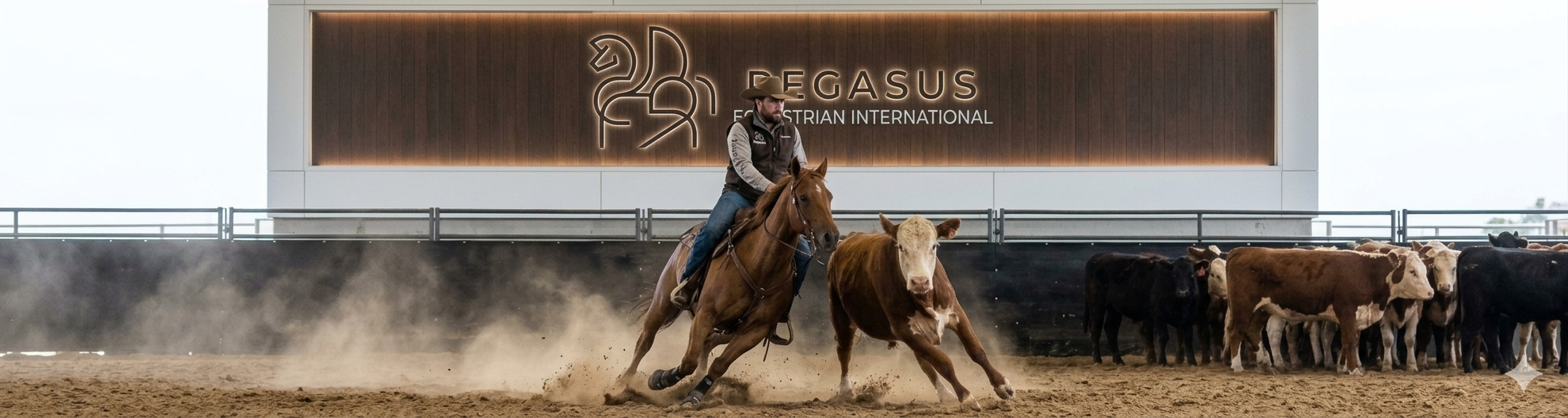
In the disciplines of Cutting and Reined Cow Horse, the quality of the livestock is the single most important variable in the integrity of the competition. The scoring in Herd Work and Cow Work is intrinsically linked to the "juice" or responsiveness of the animal.6 A horse's athleticism can only be showcased if the cow it is working has the natural movement and energy to challenge it.
The Urban Cattle Crisis
In traditional urban venues, the logistics of cattle management are a nightmare of stress and inefficiency. Thousands of head of cattle must be trucked into cities like Fort Worth or Oklahoma City, often over long distances, and kept in stressful, noisy indoor pens. These "spent" cattle quickly lose their natural instincts, leading to a "luck of the draw" scenario that undermines the fairness of the competition. Furthermore, the costs of leasing and trucking these animals are a major drain on show management budgets.
The Pegasus Pasture-to-Arena Pipeline
Pegasus, as a former 3,000-acre cattle ranch, fundamentally solves the cattle problem by internalizing the supply chain. By maintaining a resident population of 200 to 300 (1 to 2 per acre), which will meet core day-to-day needs, Pegasus can utilize rotational management on open grass, ensuring that every horse in every set is presented with a "fresh" animal. This resident herd can be supplemented as needed from Oregon Ranches, leveraging the large head of cattle in Douglas County (40,000 head as of 2022). For high-volume events like the NCHA, which requires over 1,000 cattle per day (up to 15,000 fresh cattle over three weeks), a stable on-site herd of 300 used approximately 35 times could generate 10,500 runs, meeting the logistical demands through the efficient rotation of fresh cattle.
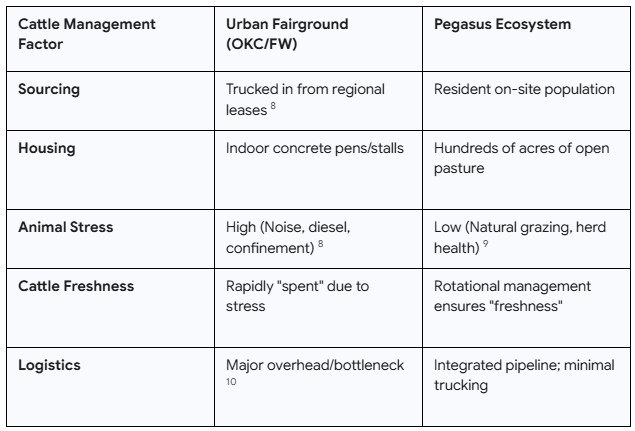
This rotational grazing model is supported by advanced soil science and pasture management. By moving animals when grass is grazed to 3-4 inches and allowing it to regrow to 6-8 inches, Pegasus maintains a high-quality forage that keeps cattle fit and responsive.11 This scientific approach to ranching ensures that the livestock are high-performance athletes in their own right, matching the caliber of the horses they face in the arena.
Climate & Land-use: The Douglas County Advantage
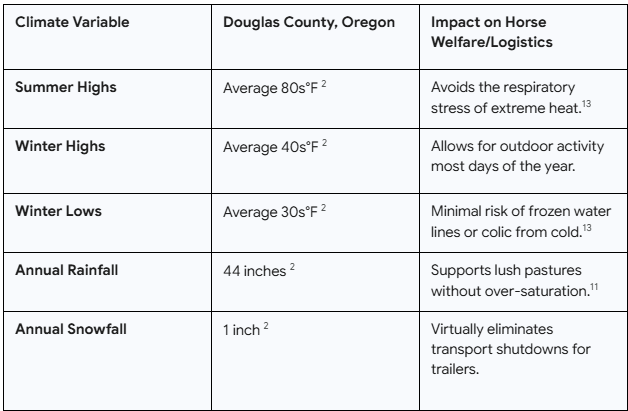
The geography of Douglas County, Oregon, provides a unique climatic "sweet spot" that is ideally suited for the year-round demands of elite equestrian sport. [2] While traditional hubs in the South and Midwest are subject to crippling heat and humidity in the summer or severe ice storms in the winter, the Pegasus site enjoys a temperate pattern that facilitates horse health and structural durability.
Another significant advantage is Oregon’s protective land use and taxation laws for Farm and Forest lands. This legally ensures that the location will NOT be surrounded by urban encroachment, protecting open land, horses, cattle, and equestrian investment in the area. This anti-gentrification model ensures the venue will not end up like Florida or other Western venues that have been aggressively surrounded by urban development and non-equestrian fairs, as detailed in the "Pegasus Equestrian International: A Paradigm Shift in Equestrian Resort Development" update report.
This mild climate is critical for the prevention of winter-related equine health issues. In regions with more extreme cold, horses are at high risk for colic due to inadequate water intake and skin disorders like rainrot or scratches from mud. [13] Pegasus mitigates these risks through a combination of Douglas County’s naturally low snowfall and advanced site engineering that prioritizes dry land and mud control. [11]
Engineering the Cathedral: The "Jewel" and Mass Timber Innovation
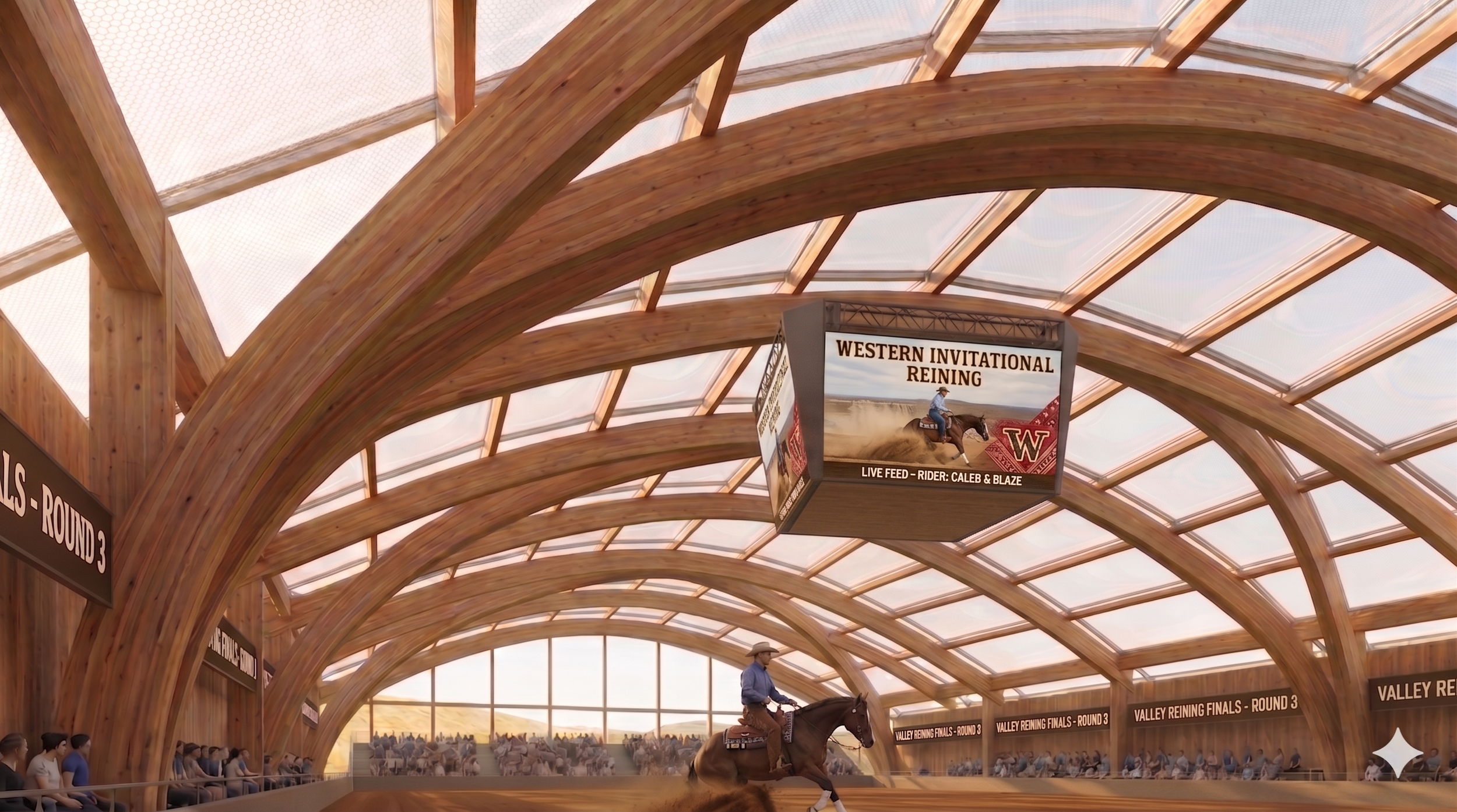
“The Jewel” arena concept during a reining event (Pegasus Equestrian International / Gemini 2026)
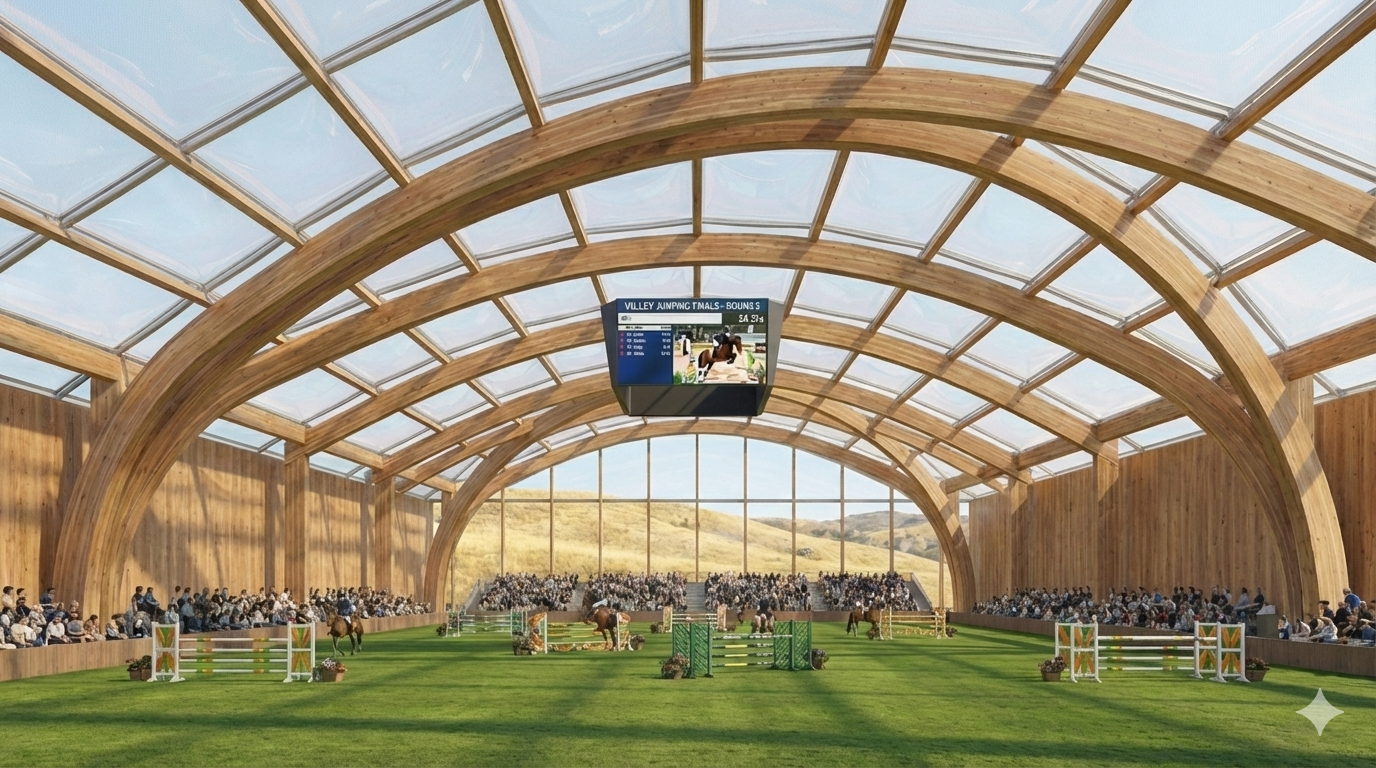
The centerpiece of the Pegasus campus is the "Jewel" Arena, a 3-acre climate-controlled indoor masterpiece that serves as the flagship prototype for the future of equestrian venues. [2] The Jewel and our additional indoor arenas are not warehouses; the Jewel is an architectural "concept car" that uses cutting-edge materials to solve the age-old problems of acoustic stress and ammonia corrosion.
Mass Timber and the Biophilic Benefit
Traditional arenas are typically built with steel and concrete—materials that are loud, cold, and susceptible to corrosion from the ammonia inherent in livestock environments. [15] Pegasus utilizes Mass Timber - engineered "super-material" manufactured in the Pacific Northwest and abroad. [15] Mass Timber products can be as strong as steel but weigh significantly less, allowing for massive clear spans without the need for interior columns that can obstruct views and create hazards. [15]
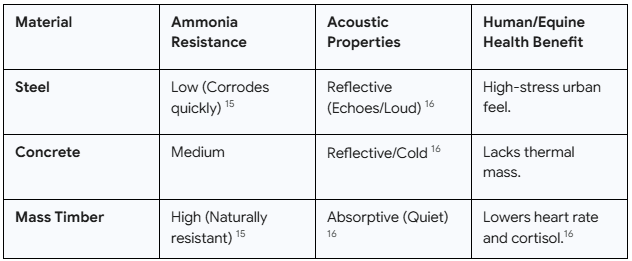
Research indicates that the presence of exposed wood in the built environment has a profound "biophilic" effect, correlating with a drop in cortisol, the primary hormone linked to stress.16 In the high-pressure world of elite reining or cutting, where a spooked horse can lose a world title in a second, the quiet, calming atmosphere of a mass timber arena provides a tangible competitive advantage. [16]
The ETFE Pneumatic Skin
The Jewel’s roof system utilizes Ethylene Tetrafluoroethylene (ETFE) panels, a polymer cushion system that is 1% the weight of glass. [15] This multi-layer pneumatic system acts as a "dimmer switch" for the sun. By adjusting air pressure, the arena can overlap printed patterns on the foil layers to block glare. [15] This eliminates the sharp shadows and moving light patches that frequently cause horses to balk or shy in traditional indoor arenas, ensuring a consistent and safe performance surface. [2]
The Parimutuel Engine: Financing the "Mega-Show"
One of the most visionary aspects of the Pegasus model is the integration of professional racing with arena performance. Historically, the Quarter Horse and Paint Horse industries have seen their racing and performance divisions split geographically, diluting their economic impact.1 Pegasus features "Stirling Downs," a professional flat track (flat, harness, and steeplechase) with a legal structure for parimutuel wagering.
Oregon's Wagering Dominance
Oregon is the undisputed capital of online wagering in the United States. In 2024, Oregon-based Advance Deposit Wagering (ADW) companies booked over $6.5 billion in bets, representing more than 90% of all internet racing bets in the country. [20] Pegasus leverages this regulatory strength, operating under a framework where wagering revenue can be directly funneled back into horse show purses. Wagering in Oregon is shown in the numbers below:
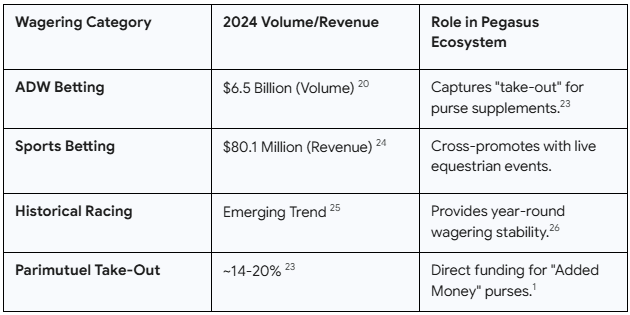
[20]
By hosting "Mega-Shows" where racing and performance occur on a single campus, Pegasus allows organizations like the AQHA and APHA to generate significantly higher "Added Money" for their flagship shows. This vertical integration eliminates the markups of third-party rental and labor, allowing the venue to act as the greatest advocate for the rider's wallet.
The Integrated Sponsorship Model: Leveraging Cross-Pollination
The convergence of multiple equestrian disciplines—including Western, English, Polo, Driving, and Racing—into a single, unified geography makes Pegasus a uniquely valuable sponsorship platform. Unlike single-use facilities where sponsorship value is siloed within one sport, Pegasus offers unprecedented cross-pollination, exposing a sponsor’s products and brand to diverse audiences who share the coveted equestrian demographic.
This integrated approach benefits all parties:
For Sponsors: The sheer diversity of events allows products to expand from one "silo" (e.g., Western) to others (e.g., English or Racing), dramatically increasing market reach and brand visibility for a single investment. Sponsors can achieve global exposure through the free-to-view format of shows broadcast from the permanent on-site media studios, which are paid for by sponsors and ads, eliminating the typical paywall barrier.
For Events and Competitors: Higher levels of sponsorship, alongside parimutuel wagering revenue, allow Pegasus to offer significantly higher purses ("Added Money") for flagship shows, improving the financial viability for competitors.
Monetization Opportunities: Pegasus is positioned to monetize events through major sponsorships of facilities (like arena naming rights) and smaller sponsorships (for printed materials and signage), as well as strategic branding partnerships involving on-site transportation, equipment, and amenities. The equestrian community is a highly coveted demographic, drawing interest from major international firms such as Longines and Rolex.
This allows for the site to have one geography, but unlimited stories. A combined equestrian site allows for advertisers and sponsors to tell an unprecedented story and reach the entire equestrian community.
The Equestrian Mile: Reimagining the Lifestyle and Retail Hub
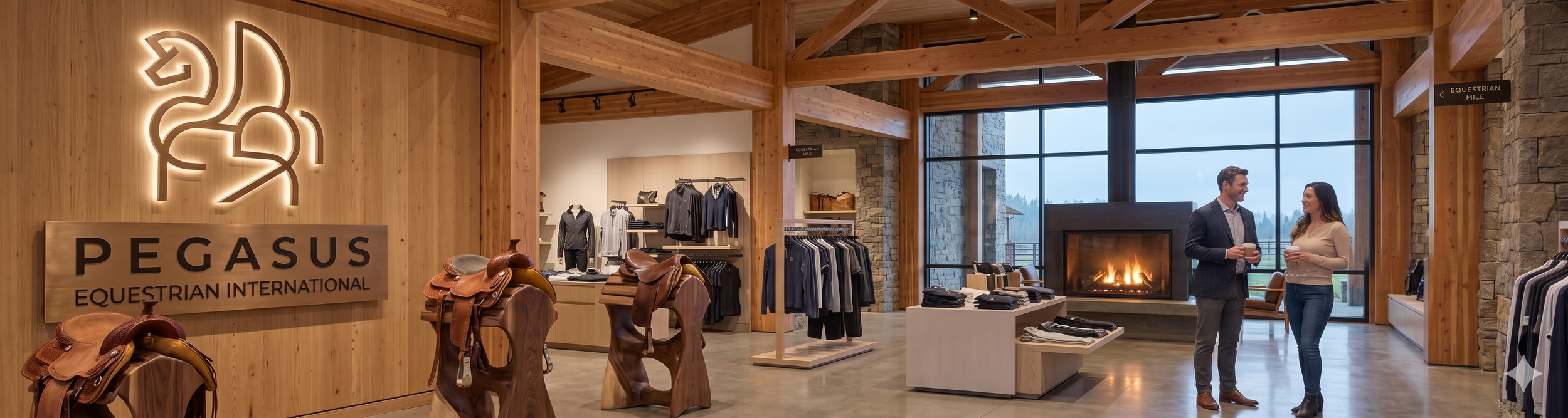
The equestrian mile (Pegasus Equestrian International / Gemini 2026)
Pegasus's Destination Resort approval requires the venue to be self-contained with not only on-site lodging, but also restaurants and full on-site conference facilities, allowing an equestrian and their organizations to complete, ride, race, eat, shop, meet, and sleep all on one controlled rural site in harmony with the needs of the equestrian world in a permanent rural setting, a feature unavailable at old country fairs or mega-venues globally.
To be a true "Total Ecosystem," Pegasus features a permanent high-end retail and social hub known as the "Equestrian Mile". In traditional fairgrounds, retail is often a temporary, "pop-up" experience in drafty exhibit halls with limited amenities. [27] The Equestrian Mile offers national brands year-round flagship space, moving away from temporary tents toward a sophisticated, curated shopping district.
The Equestrian Experience Center (EEC)
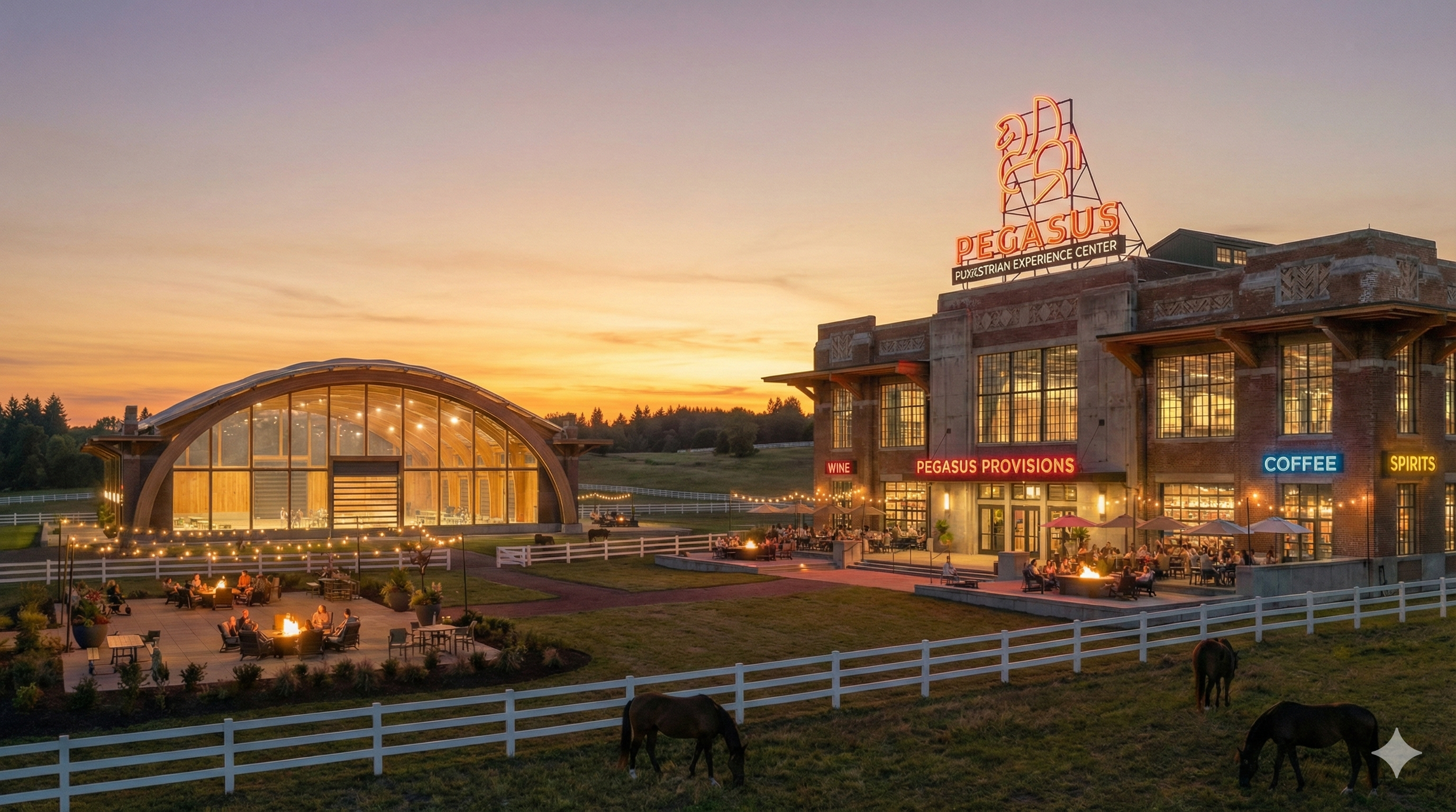
The Equestrian Experience Center Concept (Pegasus Equestrian / Gemini 2026)
The Equestrian Mile is anchored by the Pegasus Equestrian Experience Center (EEC), a "reimagined industrial landmark" designed with a "High-Industrial" aesthetic of weathered red brick and cross-laminated timber. [15]
Ground Floor: The Marketplace & Makers Hall features "Pegasus Provisions," where visitors can watch coffee roasting, brewing, and cheese making. [15]
Second Floor: High-end retail for English and Western saddles and apparel, paired with interactive projection mapping to educate the curious and uninitiated on the industry’s economic impact. [15]
Rooftop: A recessed timber deck with fire pits and views of the 65-acre box canyon, serving as the ultimate social hub for the industry. [2]
This center acts as the "front door" to the industry, turning highway travelers on I-5 into new fans and participants through jargon-free education and luxury engagement.
Logistics of the Elite: The Runway and the Interchange
For the world-class competitor, time is the most valuable commodity. The Pegasus campus is engineered for seamless access, featuring a dedicated I-5 interchange and a 5,100-foot on-site runway. This infrastructure allows the world’s top athletes and stock contractors to bypass urban gridlock, landing their private aircraft or driving their heavy semi-trailers directly onto the protected geography of the campus, in a non-urban congested, natural rural environment that is protected.
The "Mileage" Loyalty System
Recognizing the significant financial burden of traveling for national shows, Pegasus operates a "Mileage" loyalty system. Participants earn points on every on-site transaction—including lodging, food, gas, and retail—which can be redeemed for travel or event fees. This system specifically supports the youth and collegiate organizations, such as the IEA and NHSRA, ensuring that the next generation of riders has an accessible, affordable home on the West Coast.
Sustainability and the "One Geography, Many Lives" Initiative: The long-term survival of the Equestrian Industry
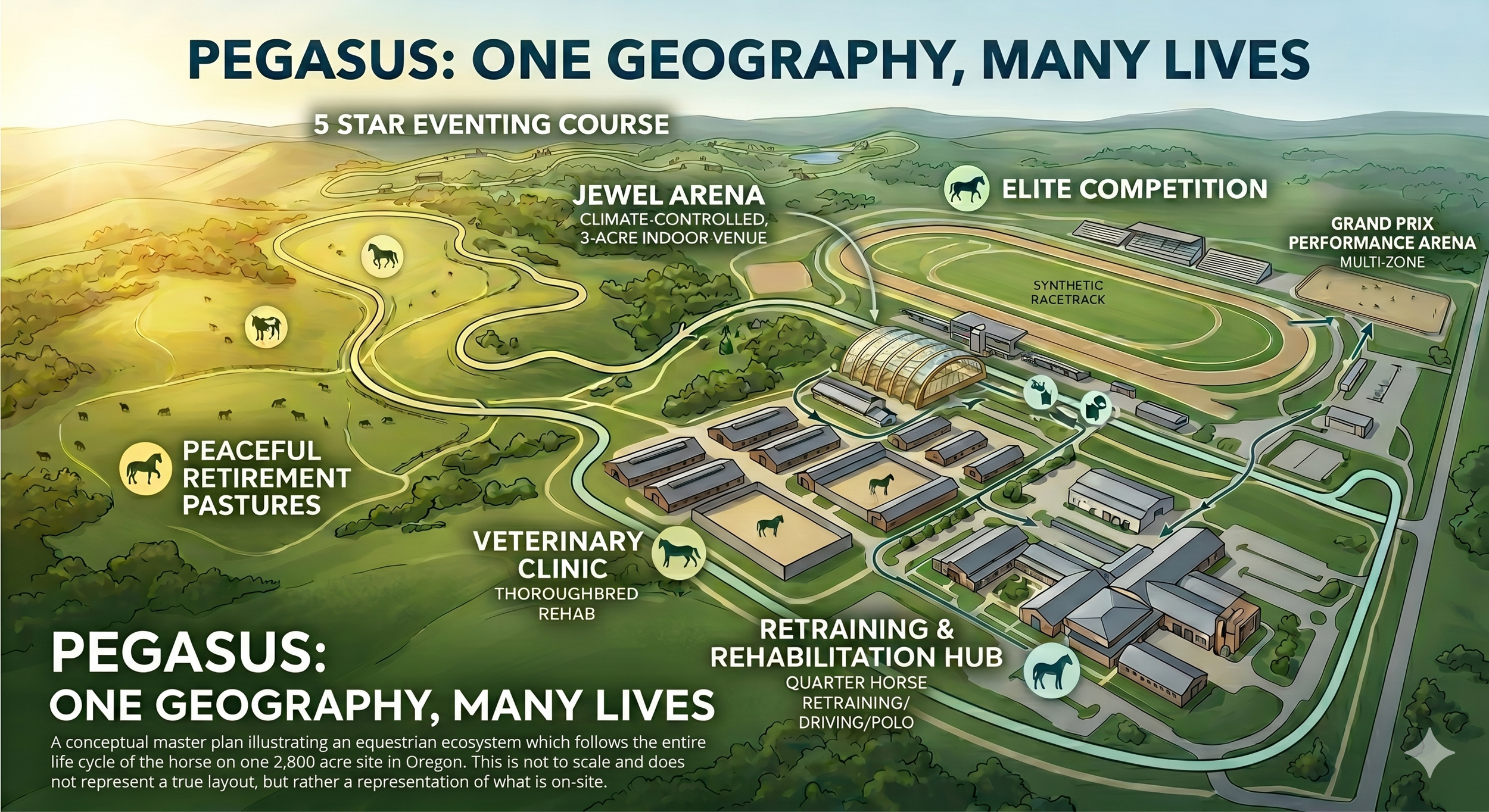
The long-term survival of the Equestrian industry is contingent upon its "social license"—the public's perception of horse welfare throughout the animal's life cycle. Pegasus addresses this head-on through its "One Geography, Many Lives" initiative, which integrates retirement and retraining into the campus.
Life-Cycle Infrastructure
The 3,000-acre site provides a "continuous line" for a horse's career:
Elite Competition: Starting in the performance arenas or the flat track. [19]
Second Careers: Retraining Thoroughbreds and Quarter Horses off the track for Western, English, Steeplechase, driving, polo, and more.
Major Veterinary Clinic: A major state-of-the-art vet clinic and research hub is approved on 39 acres on-site, providing first-line care, second opinions, rehab, and long-term research literally within walking distance of the barns.
Retirement: Providing peaceful, mild pastures for aging athletes in the lush Douglas County environment.
By making this commitment visible and permanent, Pegasus sets a new ethical standard for the industry, ensuring that the public sees a holistic, compassionate approach to the horse’s entire life.
The Regulatory Fortress: EFU Zoning and Oregon Law
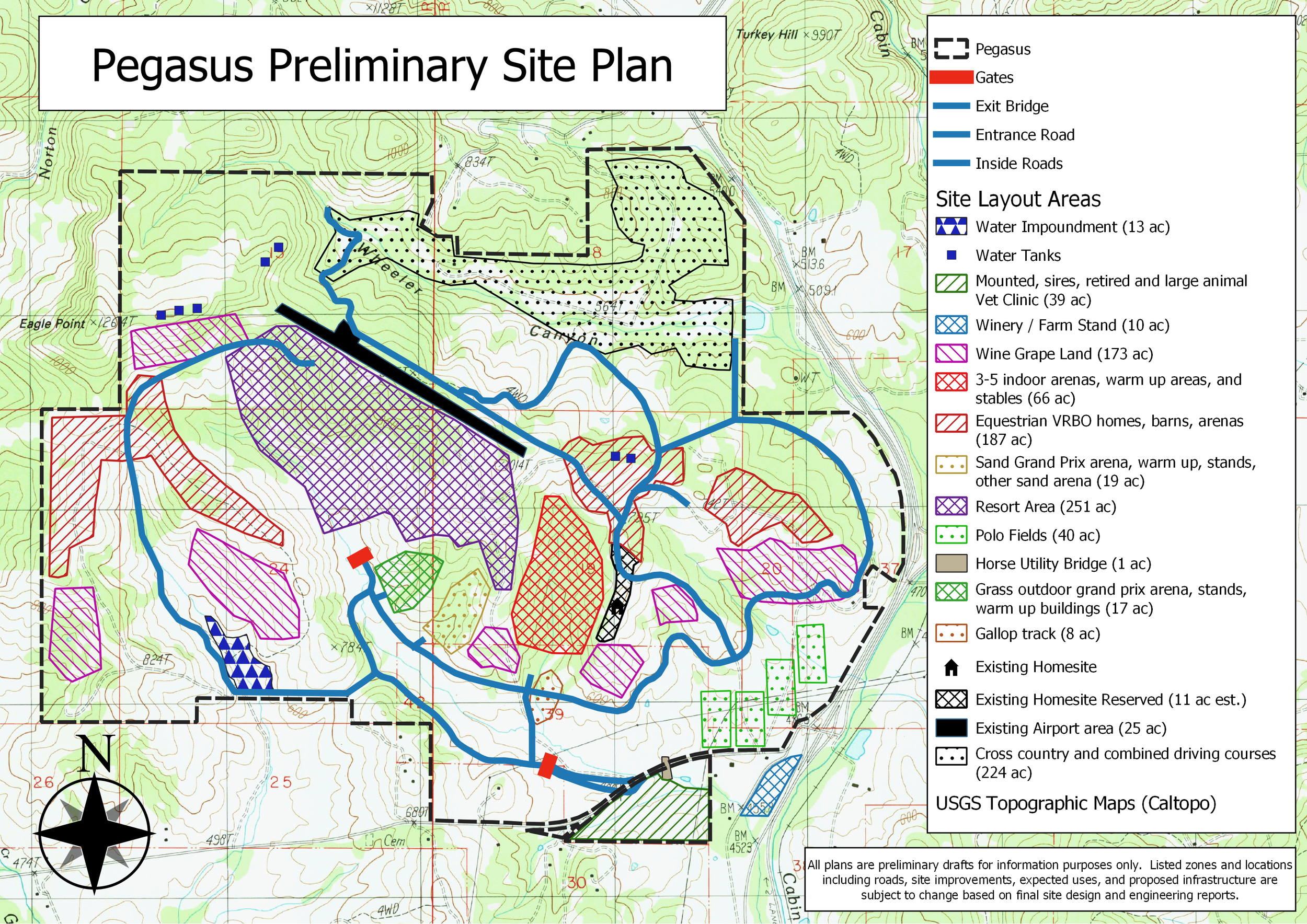
The Pegasus Equestrian Site Plan as approved by Douglas County Oregon (Pegasus Equestrian International 2026)
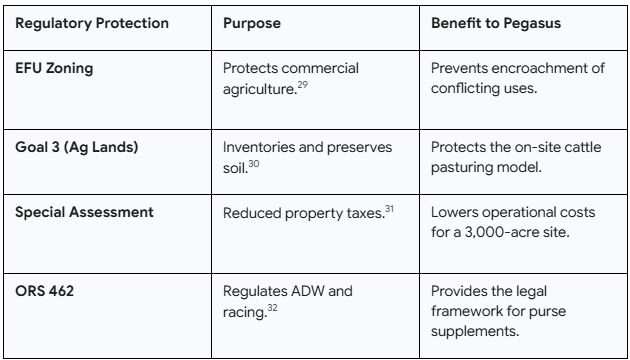
A primary reason for the decay of urban fairgrounds is the constant threat of "higher and best use" land development. Pegasus is shielded from this risk by Oregon’s strict Land Conservation and Development Act. [29] The site is protected under Exclusive Farm Use (EFU) zoning, which prevents the division of the land into residential subdivisions and ensures it remains a dedicated equestrian sanctuary for generations.
[29]
This "regulatory fortress" ensures that the investment in Pegasus is permanent. Unlike urban sites that are currently facing decommissioning or conversion, Pegasus is built on ground that is legally preserved for the horse and the rider.
Conclusion: Claiming the Future of the West
The transition from aging, land-locked urban fairgrounds to the Pegasus Equestrian International ecosystem is not just a luxury—it is a necessity for the long-term survival of the equestrian spirit. We are moving past the era of the "rental venue" toward a future of vertical integration, where the venue owner is also the greatest advocate for the rider's wallet and the horse's welfare.
By providing a 3,000-acre unified site that integrates elite arena competition, professional racing, and natural cattle management—and offers an unparalleled sponsorship platform that drives higher purses—Pegasus eliminates the stressors of urban competition and the barriers of paywalled media. We are offering the "Big 10" and every rodeo athlete a more profitable, convenient, and ethically sustainable home. The frontier isn't closing; it is simply moving to a place where it can finally be permanent. Douglas County, Oregon is not just a location—it is the foundation upon which the next century of Western heritage will be built.
References / Further Reading
Omitted
From $400 Million Dreams to Grounded Reality: How We Are ..., accessed April 28, 2026, https://pegasuseq.com/updates/jewel-of-oregon
The Gap Report: Ohio has just 37 units of affordable housing for every 100 extremely low-income renter households - The Center for Community Solutions, accessed April 28, 2026, https://www.communitysolutions.com/resources/the-gap-ohio-has-just-37-units-of-affordable-housing-for-every-100-extremely-low-income-renter-households
What is the Payout at the 2025 NFR? - CalfRoping.com, accessed April 28, 2026, https://calfroping.com/what-is-the-payout-at-the-2025-nfr/
Where to Stay in Las Vegas During NFR 2024: The Ultimate Guide - Justin Boots, accessed April 28, 2026, https://www.justinboots.com/en/boot-prints/where-to-stay-in-vegas-during-nfr-2024.html
2025 NRCHA Snaffle Bit Futurity® Program - Issuu, accessed April 28, 2026, https://issuu.com/thenrcha/docs/2025_nrcha_snaffle_bit_futurity_program
Scoring Draw V2 - National Reined Cow Horse Association - NRCHA, accessed April 28, 2026, https://www.nrcha.com/scoring-draw-v2?event_id=1&sub_id=720
Changing cost of cattle transportation - Beef Magazine, accessed April 28, 2026, https://www.beefmagazine.com/farm-business-management/changing-cost-of-cattle-transportation
Douglas County - Natural Resources Conservation Service, accessed April 28, 2026, https://www.nrcs.usda.gov/state-offices/oregon/douglas-county
accessed December 31, 1969, https://www.ncha.com/news/industry-updates/
Managing small-acreage horse farms in Western Oregon and Western Washington, accessed April 28, 2026, https://extension.oregonstate.edu/catalog/ec-1558-managing-small-acreage-horse-farms-western-oregon-western-washington
Pasture and Livestock Essentials - Clackamas Soil and Water Conservation District, accessed April 28, 2026, http://conservationdistrict.org/wp-content/uploads/2024/11/Pasture-and-Livestock-Essentials-OSU-Living-on-the-Land.pdf
Winter Equine & Livestock Care Tips | Oregon Veterinary Medical Association, accessed April 28, 2026, https://www.oregonvma.org/care-health/equine-and-livestock/health-safety/winter-equine-livestock-care-tips
Horse Health and Water Quality - Oregon.gov, accessed April 28, 2026, https://www.oregon.gov/oda/Documents/Publications/naturalresources/HorseHealthWaterQualitybrochure.pdf
Pegasus Equestrian Experience Center: A Reimagined Industrial ..., accessed April 28, 2026, https://pegasuseq.com/updates/pegasus-equestrian-experience-center-concept
How Mass Timber Enhances Wellness in the Built Environment | Sterling Structural, accessed April 28, 2026, https://sterlingstructural.com/how-mass-timber-enhances-wellness-in-the-built-environment/
Beyond sustainability: four remarkable benefits of mass timber | www.usa.skanska.com, accessed April 28, 2026, https://www.usa.skanska.com/who-we-are/media/constructive-thinking/beyond-sustainability-four-remarkable-benefits-of-mass-timber/
A Literature Review on the Health Impacts of Wood and Mass Timber Buildings, accessed April 28, 2026, https://carbonleadershipforum.org/a-literature-review-on-the-health-impacts-of-wood-and-mass-timber-buildings/
Country Sports: An Equestrian Campus With Racing Attached, Not ..., accessed April 28, 2026, https://pegasuseq.com/updates/country-sports
The Oregon Racing Commission No Longer Wants Oregonians to Know the Sources of Its Funding - Willamette Week, accessed April 28, 2026, https://www.wweek.com/news/2025/05/14/the-oregon-racing-commission-no-longer-wants-oregonians-to-know-the-sources-of-its-funding/
Racing Commission abruptly reverses policy that reduced disclosure of revenue sources - The New Era | Sweet Home, OR, accessed April 28, 2026, https://www.sweethomenews.com/racing-commission-abruptly-reverses-policy-that-reduced-disclosure-of-revenue-sources/
2025-27 Budget Review – Oregon Racing Commission, accessed April 28, 2026, https://olis.oregonlegislature.gov/liz/2025r1/Downloads/CommitteeMeetingDocument/297784
Parimutuel betting - Wikipedia, accessed April 28, 2026, https://en.wikipedia.org/wiki/Parimutuel_betting
oregon - American Gaming Association, accessed April 28, 2026, https://www.americangaming.org/wp-content/uploads/2025/02/Oregon_Overview.pdf
Oregon Revised Statutes § 462.155 (2025) - Wagering on races previously held., accessed April 28, 2026, https://law.justia.com/codes/oregon/volume-13/chapter-462/section-462-155/
PARI-MUTUEL WAGERING AND HHR - Key Points - - Wyoming Legislature, accessed April 28, 2026, https://wyoleg.gov/InterimCommittee/2024/02-20240507HollandAndHart-PariMutuelWageringHHR.pdf
HELPFUL HINTS & VENDOR / PARTICIPANT REMINDERS - OKC Fair Park, accessed April 28, 2026, https://okcfairpark.com/wp-content/uploads/2025/08/Helpful-Hints-for-Show-Vendors-Exhibitors.pdf
Exhibitor Services Manual - Oklahoma State Fair, accessed April 28, 2026, https://okstatefair.com/wp-content/uploads/2025/07/Superior-Expo-Manual.pdf
Department of Land Conservation and Development : Farmland Protection : Farm and Forest : State of Oregon, accessed April 28, 2026, https://www.oregon.gov/lcd/ff/pages/farmland-protection.aspx
OREGON FARM & FOREST LAND USE REPORT 2018 –2019, accessed April 28, 2026, https://www.oregonlegislature.gov/committees/2019I1-HAGLU/Reports/2018-2019%20DLCD%20Farm%20Forest%20Report.pdf
Farm / Forest | Douglas County, OR, accessed April 28, 2026, https://www.douglascountyor.gov/165/Farm-Forest
Oregon Revised Statutes, accessed April 28, 2026, https://www.oregonlegislature.gov/bills_laws/ors/ors462.html
The Main Arena Conceptual Design - the “Jewel” of Oregon
The Polo Grounds Conceptual Design
Pegasus Equestrian Experience Center Concept
The team at Pegasus Equestrian International Resort & Venue is excited for what is sure to be a “once-in-a-generation” project that will stand out for years to come.
Pegasus has limited opportunity for accredited investors in this early stage - but that window with preferential terms is short. Reach out today. Call, email, or inquire here.
We are developing what could be the number one show park in North America and a world class destination even if you do not ride in on a horse. We look forward to hosting you.
- Drew Millegan, Quinn Millegan, and the Pegasus Equestrian team
info@pegasuseq.com | (800) 651-1996
See more information below on our team and project:
Pegasus Equestrian Experience Center
Linda Royer: Lead Equine Designer
Mary Arnstad: Hotel & Resort Management Lead
Paul Cunningham: International Equine Adviser
David Gorman: Environmental & Ecological Engineer
Drew & Quinn Millegan: About the Founders
