
Country Sports: An Equestrian Campus With Racing Attached, Not the Other Way Around
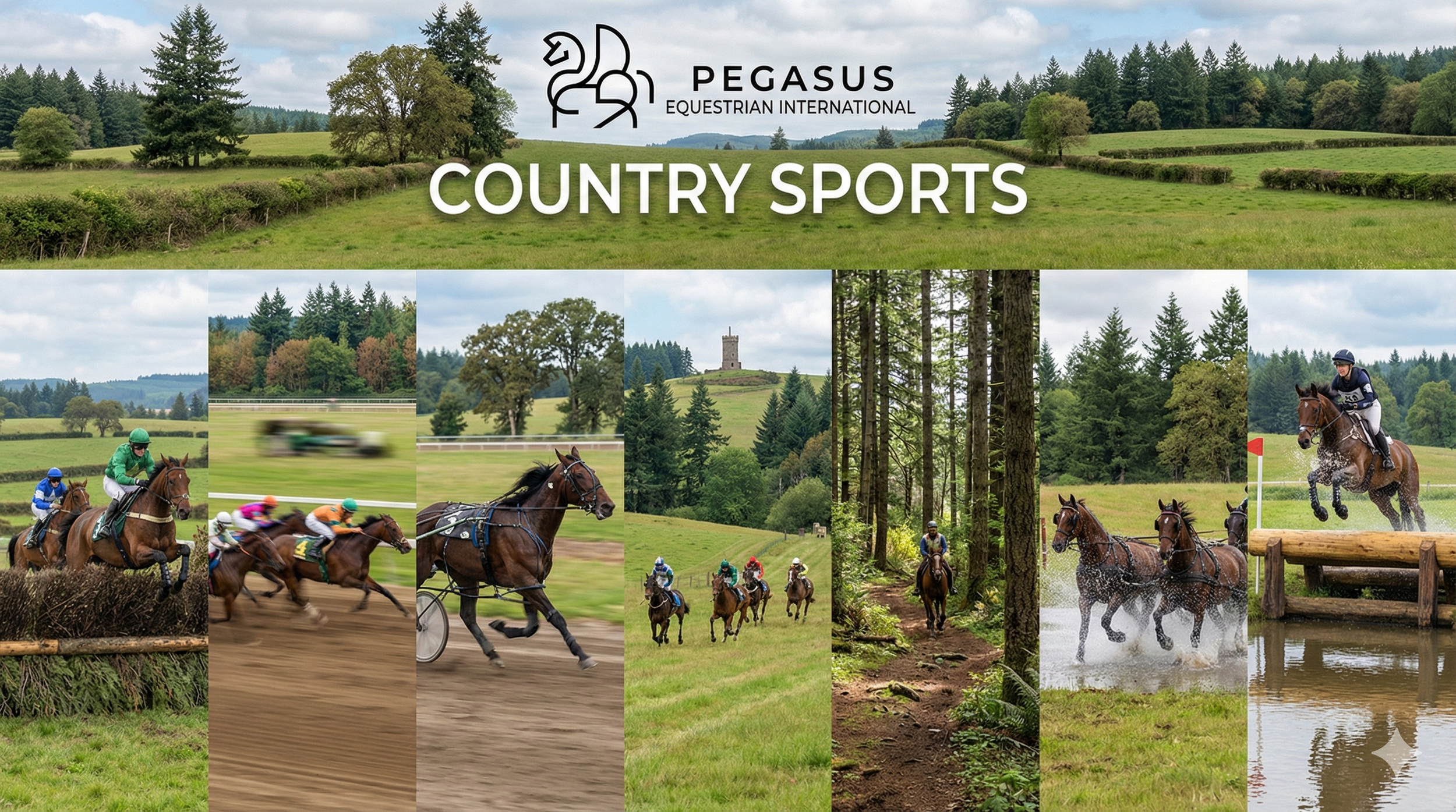
Pegasus Equestrian International "Country Sports"
Also posted on LinkedIn here.
On nearly 3,000 acres in northern Douglas County, Oregon, Pegasus Equestrian International / Stirling Downs is conceived first as a multi‑discipline equestrian campus and resort, and only then as a racing venue.
The foundation is:
Year‑round hunter/jumper, dressage, polo, western, eventing, driving, and other FEI‑style sports in both climate‑controlled and outdoor arenas.
Boarding, training, clinics, and academies.
Lodging, food and beverage, conferences, and tourism.
Racing is layered in as an additive program: flat, harness, steeplechase (track and country), and point-to-point designed to be self‑supporting and explicitly subsidy‑free, rather than depending on gaming or public funds. The result is an equestrian business that stands on its own feet, with racing as a high‑impact anthology series rather than a daily soap opera.
Climate, Topography, and the 120–160 Race‑Day Window
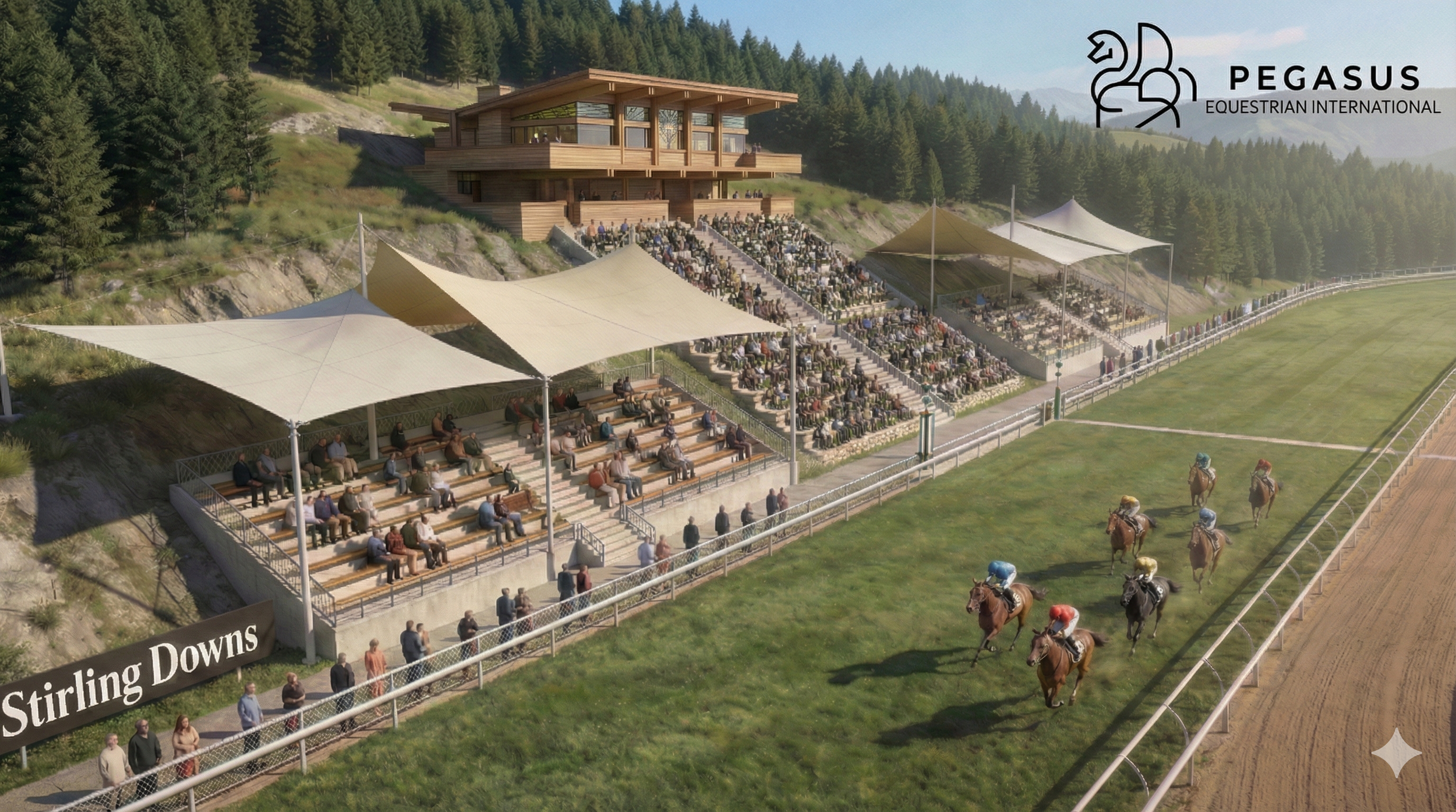
Stirling Downs at Pegasus Equestrian (Pegasus Equestrian International / Gemini 2026)
The local climate delivers warm, dry summers and mild, wet winters: July highs in the low 80s °F, January lows around the mid‑30s, roughly 30-40 inches of rain, about 150 rainy days, and barely a dusting of snow each year. Compared with winter‑bound New Jersey, Indiana, or Ontario, where January lows plunge into the teens or low 20s and snow routinely shuts down or compromises racing surfaces, this is a markedly kinder environment for outdoor horses.
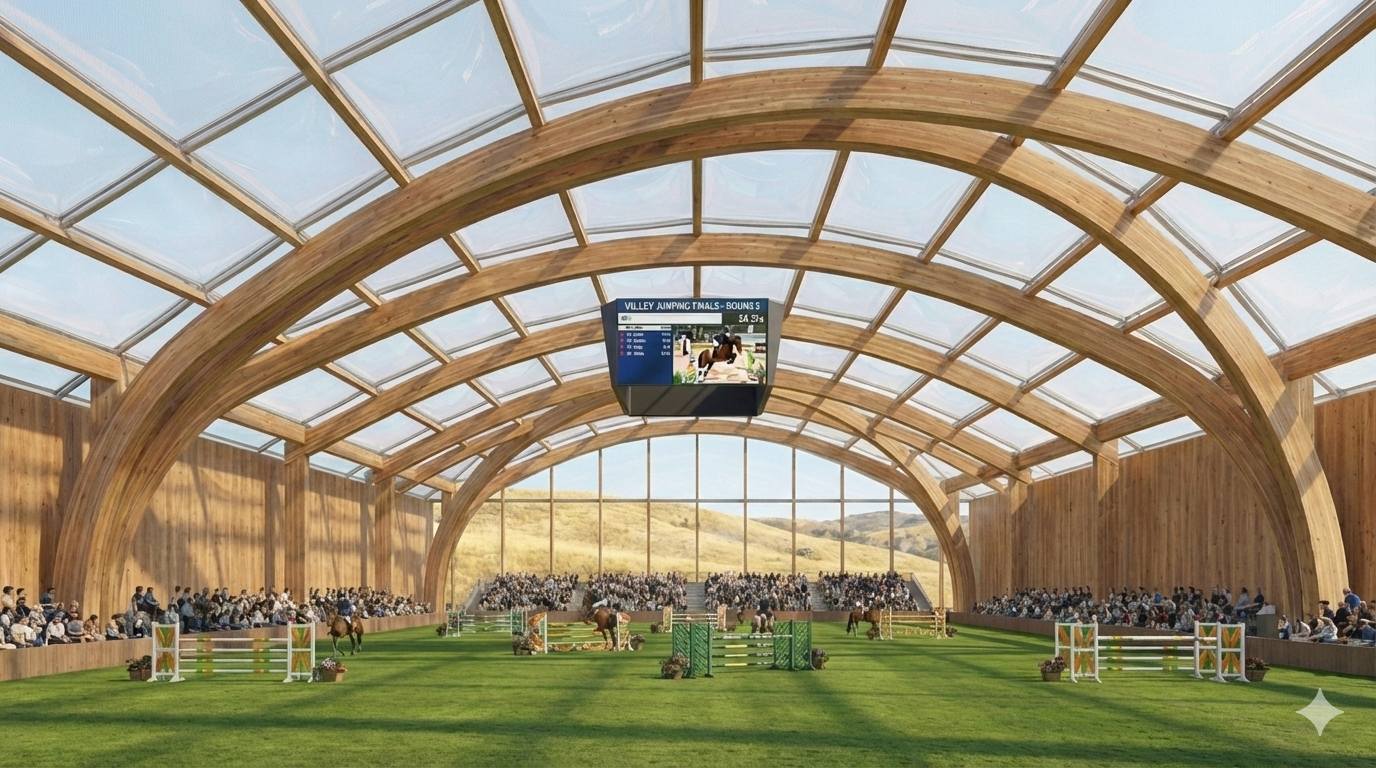
The Indoor "Jewel" Arena Concept (Pegasus Equestrian International / Gemini 2026)
Those conditions, combined with well‑drained outdoor ovals and climate‑controlled arenas, give Pegasus a realistic target of 120–160 live race days per year across all codes:
Flat and harness cards as the backbone of the calendar.
Spring and autumn steeplechase meetings on an inner turf course.
Occasional country steeplechase and point‑to‑point festivals over the hills.
Endurance rides that start and finish on site.
On the wettest winter days, the training load simply swings inside. That flexibility, built into the infrastructure, is what allows Pegasus to talk about 120–160 days of live racing with a straight face.
Racing as a Curated Layer on a Broader Ecosystem
Within this ecosystem, racing is designed to be curated rather than desperate. This positions racing as a growth opportunity, rather than a struggling legacy system. This positions racing as a growth opportunity, rather than a struggling legacy system.
Flat and harness racing are the most frequent and familiar formats. Around them, Pegasus layers:
Track steeplechase, using a turf or turf‑like inner course and portable fences to steeplechase standards, primarily in the spring and fall.
A country steeplechase circuit over rolling ground, which can double as a cross‑country course when not in use for racing.
Point‑to‑points, in partnership with hunt or countryside‑sport organizations, for amateur jump racing and social festival days.
Endurance rides, with distances from entry‑level to 100‑mile, starting and ending on the same campus that hosts elite showjumping and dressage the week before.
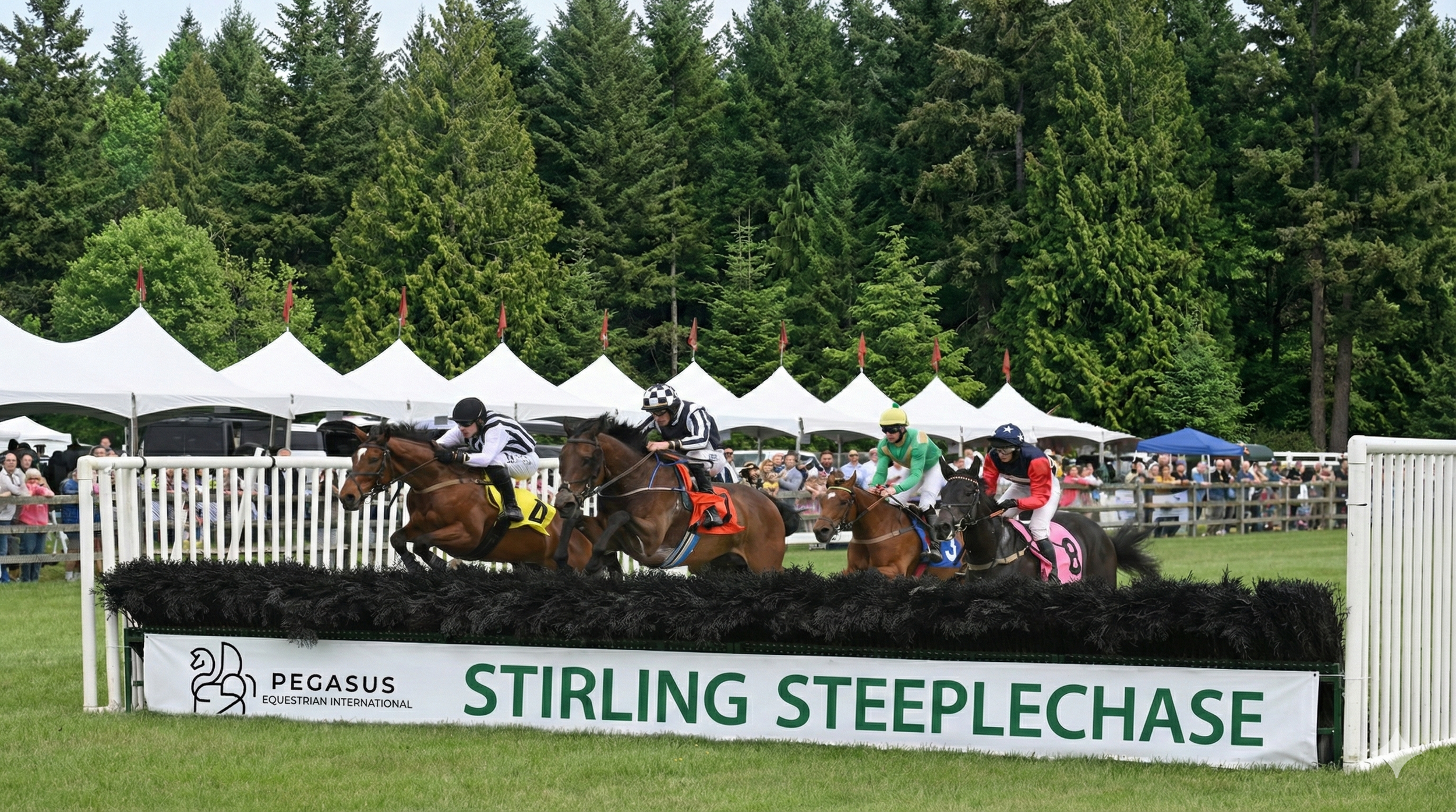
Stirling Steeplechase Concept at Pegasus Equestrian (Pegasus Equestrian International / Gemini 2026)
Because hunter/jumpers, dressage, eventing, training, hospitality, and clinical work are the primary revenue drivers, each racing code can be scaled to fit demonstrated demand and welfare outcomes. That is a very different posture from tracks that must chase volume to keep the lights on.
A Newmarket‑Scale Training Landscape in the Pacific Northwest
Most North American training centers operate on tens or low hundreds of acres; Pegasus has nearly 3,000. Newmarket’s training grounds in the U.K., with their famous hill and turf gallops, cover roughly 2,500 acres, and Lambourn’s about 600. Pegasus therefore sits in genuinely rarefied company.
Current science and longstanding horsemanship both point in the same direction: hills and varied terrain are good for horses. Hill work and uneven footing, used thoughtfully, improve cardiovascular fitness, strengthen tendons and ligaments, develop topline and hindquarter power, and sharpen balance and proprioception—while allowing more work at lower speed, reducing repetitive concussion from flat, fast gallops. Regular turnout and varied exercise also correlate with healthier joints, better bone density, calmer behavior, and fewer stereotypies.
On this landscape, a horse’s life can look like a continuous line instead of a cliff:
Young horses introduced in arenas and on gentle hill tracks.
Peak careers on the flat or in harness, backed by proper conditioning, not just lap after lap.
Logical progression into steeplechase or point‑to‑point for horses that enjoy jumping.
Second and third careers in eventing, hunter/jumper, dressage, endurance, driving, polo, western or trail work, all without changing zipcodes.
The site becomes a physical expression of the “comprehensive retirement and retraining hub” concept: one geography, many lives.
The 39‑Acre Clinic and Research Campus
Then there is the 39‑acre plot reserved with land use approvals for an animal clinic and research hub—an expanse that makes even leading equine hospitals look compact.
World Equestrian Center – Ocala, for example, hosts the UF Veterinary Hospital at WEC, a sophisticated sports‑medicine and primary‑care facility woven into the showgrounds. Newmarket’s Rossdales and other referral centers bring high‑end diagnostics and surgery to the doorstep of thousands of racehorses in training. The University of Kentucky’s Gluck Equine Research Center provides a dense node of equine science and epidemiology, feeding insights back into the Thoroughbred world.
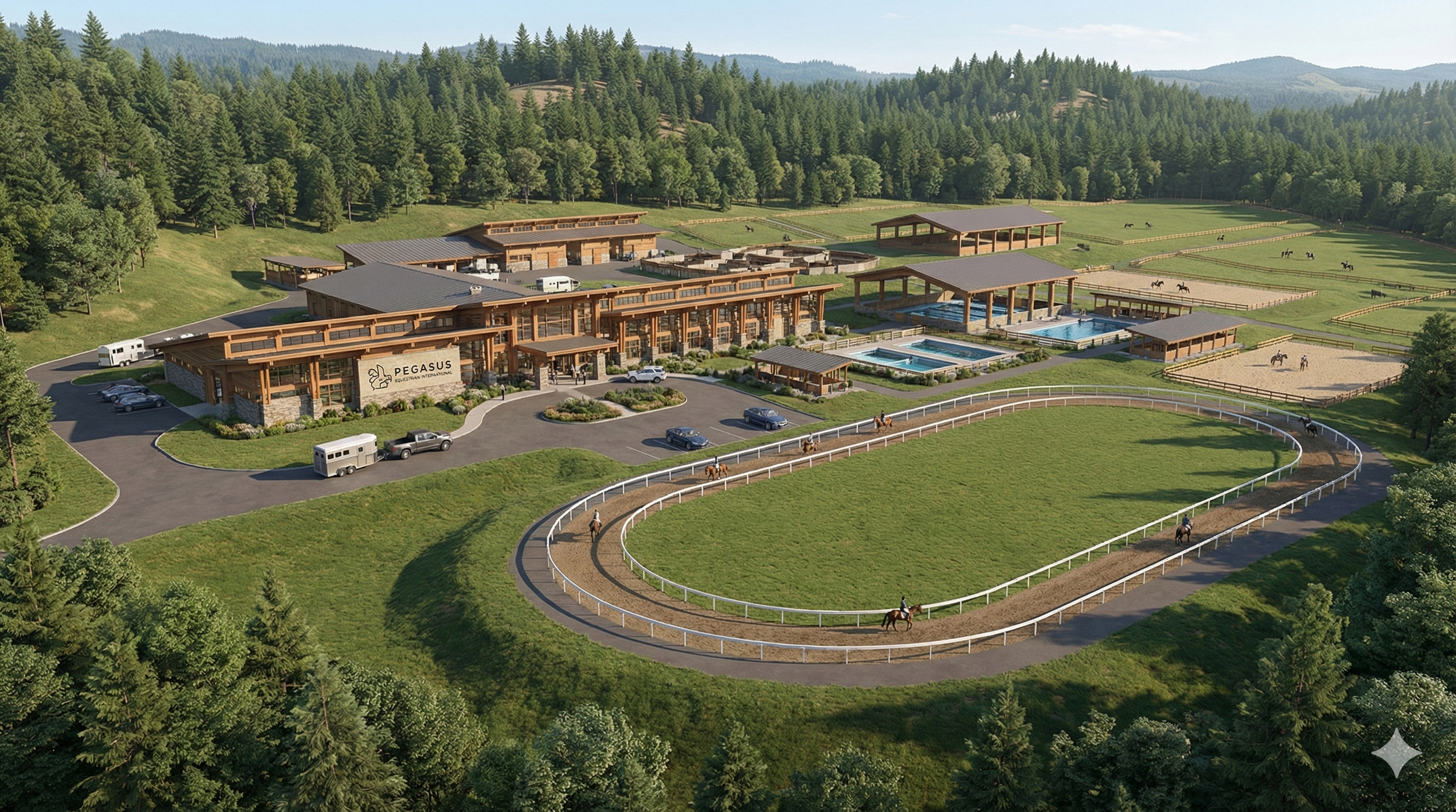
Pegasus proposes to combine all of those functions on a single, 39‑acre canvas inside the resort:
Pegasus Vet Clinic Conceptual Design (Pegasus Equestrian International / Gemini 2026)
A full equine hospital: surgery, imaging (X‑ray, ultrasound, CT, MRI, PET), internal medicine, ICU, emergency.
Rehabilitation facilities: water treadmills, pools, spas, controlled‑slope tracks.
Research labs focused on injury prevention, surfaces, genetics, nutrition, behavior, and rider safety.
Convalescent paddocks and rehab fields integrated with the surrounding hill country.
Lecture theatres and teaching barns for vets, trainers, riders, and the public.
For horses and professionals alike, that means first‑line care, second opinions, rehab, and long‑term research literally within walking distance of the barns. For the broader equestrian community, it creates a Western counterpart to Newmarket or Ocala—a place where real‑time science and daily practice inform one another.
The Equestrian Experience Center: Front Door, Classroom, Shop, and Embassy
Pegasus Equestrian Experience Center Concept (Pegasus Equestrian International / Gemini 2026)
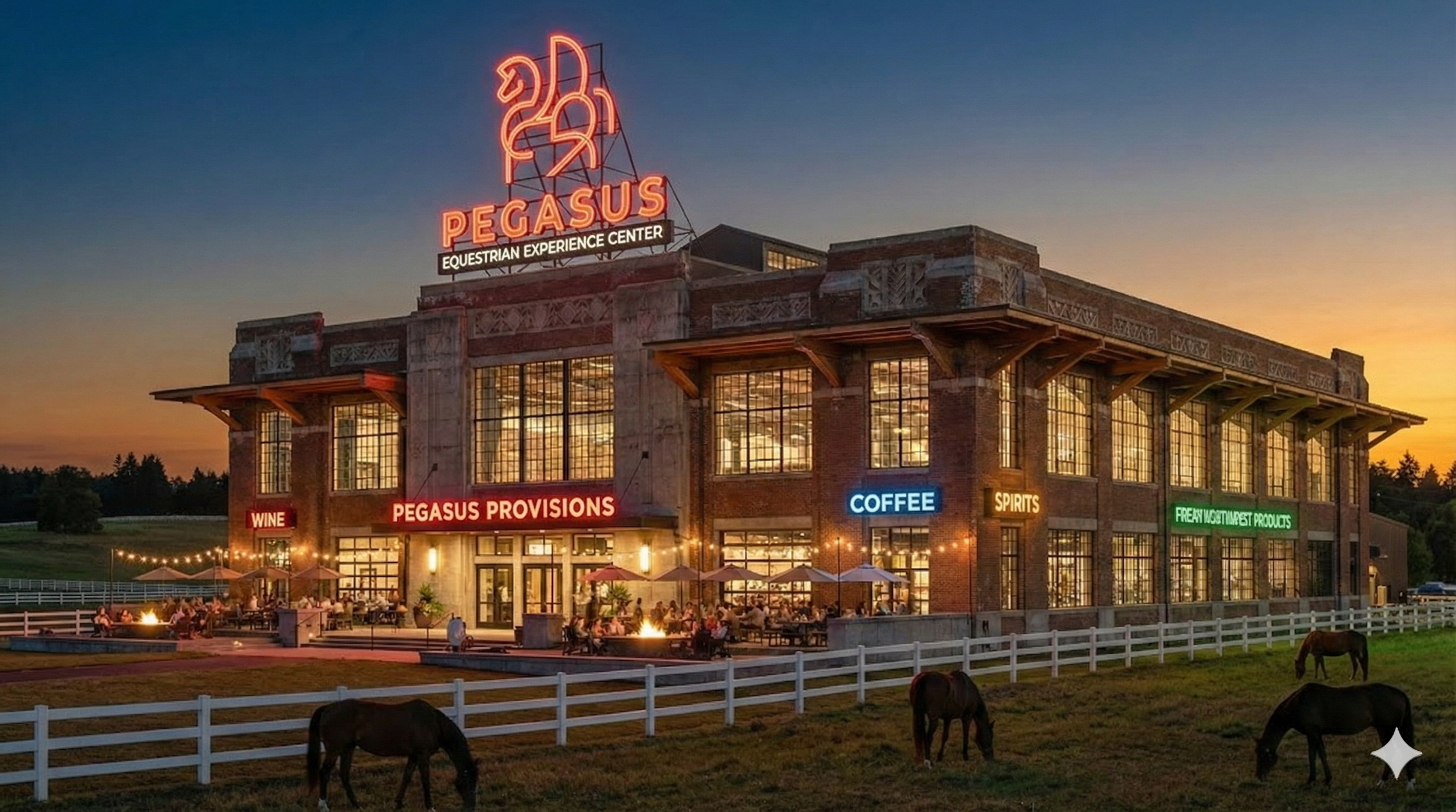
The Equestrian Experience Center sits at the junction of sport, hospitality, and civic life. Under a roof designed to be impossible to miss, it pulls triple—and arguably quadruple—duty:
Revenue engine
Curated retail: tack, apparel, art, books, regional products.
Ticketed experiences: barn tours, meet‑the‑horse sessions, vet‑for‑a‑day workshops.
Food and beverage that tell a Pacific Northwest story.
Resort concierge
One counter for everything: show entries, trail rides, spa appointments, wine tours, kids’ programs.
Real humans and digital tools helping guests stitch together a stay that might include a dressage CDI, an endurance clinic, and a day of fishing (yes we even have a salmon stream on site that we are restoring).
Equestrian education hub
Clear, jargon‑free explanations of how each discipline works.
Exhibits on modern welfare science: surfaces, vet care, aftercare, retirement.
A simple, honest guide to pari‑mutuel wagering: what it is, how it funds the sport, and how to engage responsibly.
Oregon’s visitor and product showcase
Acts as a de facto state visitor center, highlighting local foods, wines, crafts, towns, and landscapes.
Positions Pegasus as a gateway to the wider region, not a bubble sealed off from it.
For the lifelong rider, it is a clubhouse and information desk. For the family that just pulled off I‑5 because the building looked interesting, it is a gentle, entertaining introduction to why horse sports exist and why they deserve careful, critical support rather than a reflexive ban.
Meeting the Needs of Horse and Horseperson, All in One Place
Viewed as a whole, Pegasus is less a single facility and more an ecosystem:
Land on the scale of Newmarket, in a softer climate, devoted to training, turnout, and competition.
A modern race program with 120–160 live days spanning flat, harness, steeplechase, point‑to‑point, and endurance—designed to live comfortably on top of, rather than instead of, a thriving show and resort business.
A hospital and research campus large enough to change the standard of care, not just match it.
An Experience Center that welcomes the expert, the casual visitor, and the skeptic, and gives each a reason to care about horses.
For the professional rider, the amateur, the trainer, the breeder, the vet, the farrier, and the simply curious member of the public, that combination covers nearly every need in the horse–human partnership: work, rest, learning, healing, competition, and retirement—on one site, under a philosophy that is very clear about one thing.
If equestrian sport deserves a future, this is what that future should look like.
Village of Stirling at Pegasus Conceptual Design (Pegasus Equestrian International / Gemini 2026)

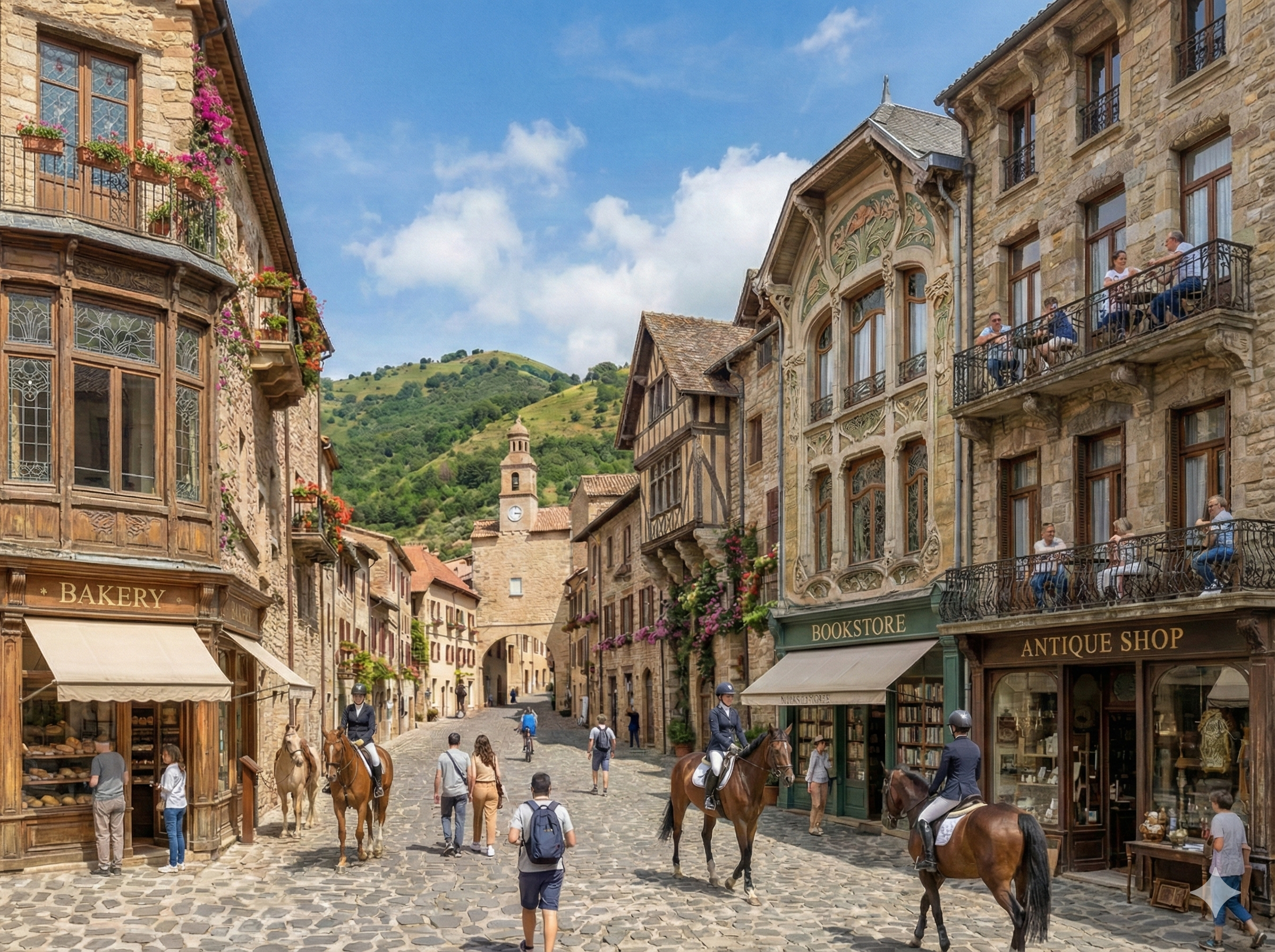
The Hillside Resort Village Conceptual Design

The Main Arena Conceptual Design - Inspired by the Olympia in London

The Polo Grounds Conceptual Design
The team at Pegasus Equestrian International Resort & Venue is excited for what is sure to be a “once-in-a-generation” project that will stand out for years to come.
Pegasus has limited opportunity for accredited investors in this early stage - but that window is short and closing. Reach out today. Call, email, or inquire here.
We are developing what could be the number one show park in North America and a world class destination even if you do not ride in on a horse. We look forward to hosting you.
- Drew Millegan, Quinn Millegan, and the Pegasus Equestrian team
info@pegasuseq.com | (800) 651-1996
See more information below on our team and project:
Linda Royer: Lead Equine Designer
Mary Arnstad: Hotel & Resort Management Lead
Paul Cunningham: International Equine Adviser
David Gorman: Environmental & Ecological Engineer
Drew & Quinn Millegan: About the Founders
