
From $400 Million Dreams to Grounded Reality: How We Are Building the "Jewel" of Oregon
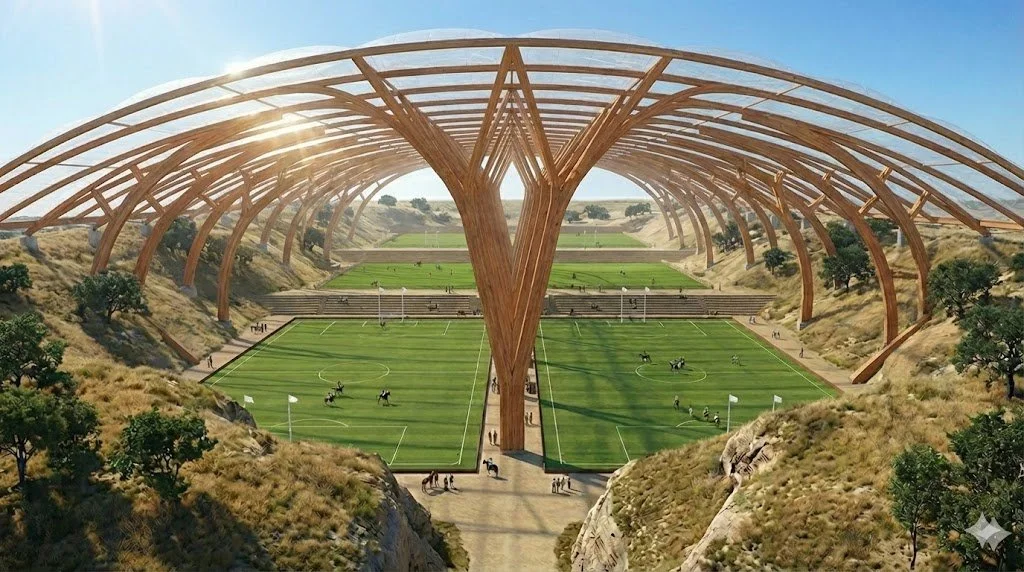
Earlier “Pie in the Sky” conceptual design covering the entire canyon (Gemini / Pegasus Equestrian)
Also posted on Linkedin: https://www.linkedin.com/pulse/from-400-million-dreams-grounded-reality-how-we-jewel-quinn-millegan-2fmec
The Pie in the Sky vs. The MVP
In the development world, there is often a massive gap between the initial artistic vision and the "Minimum Viable Product" (MVP) that actually allows a business to cash flow. At Pegasus Equestrian International, we aren't immune to this.
When we first looked at our site—a spectacular 2,800-acre landscape in Douglas County, Oregon—we were captivated by the massive box canyon at its heart. The original dream? Cover the whole thing. We looked at spanning the canyon from ridge to ridge, creating a roof over 130 acres with a floor area of 65 acres. It would have been an engineering marvel.
It also would have cost approximately $400 million.
That is the definition of "Pie in the Sky" for an equestrian venue. But Pegasus isn't about building monuments to ego; it’s about building a sustainable, profitable engine for equestrian sport. So, we pivoted. We went back to the drawing board to find a solution that respects the land, serves the horses, and actually pencils out financially.
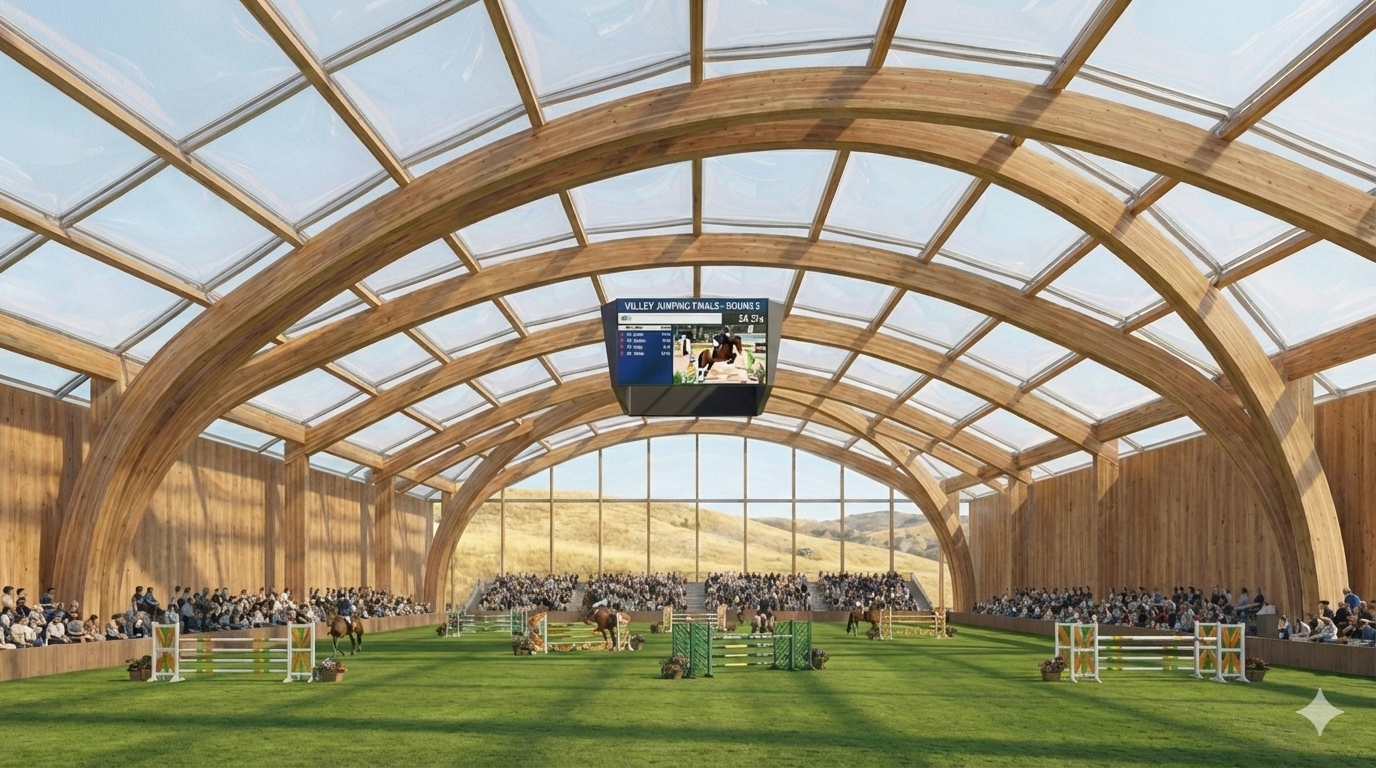
The Jewel Concept (Gemini / Pegasus Equestrian)
The New Plan: Contouring the Canyon
Instead of fighting gravity with a massive bridge structure, or aggressively terracing the land with heavy machinery, we are taking a "light touch" approach. We will work with the geology of the 65-acre canyon floor, utilizing a contoured design that minimizes expensive grading while maximizing functionality.
This approach allows us to tuck the 3-acre indoor arena structure into the landscape rather than imposing upon it.
The Layout:
The Front (25 Acres): This flatter section at the canyon mouth is dedicated to two level grass polo fields. We’ve designed covers for these for year-round play, but in the spirit of the MVP, those will wait until cash flow allows.
The Middle (Grass Arenas & The Jewel): Moving deeper into the canyon, we utilize the natural contours to place our outdoor grass competition arenas. Crucially, this is where we will situate the "Jewel" Prototype Arena. We have identified a specific location that requires minimal grading, allowing us to drop this 3-acre structure into place without massive earth-moving costs.
The Back (Sand Arenas): The upper canyon will house sand Grand Prix arenas. Here, we are turning a challenge into an asset: instead of building expensive concrete bleachers, we will utilize the natural slopes of the hillsides to provide tiered outdoor seating. Spectators can watch world-class show jumping from the comfort of a grassy berm, creating a unique "amphitheater" vibe that only this site can offer.
Environmental Integrity:
It is important to clarify the nature of this canyon. This is not a delicate wetland. Due to decades of prior logging and cattle grazing, the canyon floor contains only seasonal drainage ways, no wetlands, and no environmentally sensitive habitat. It is a working landscape that we are rehabilitating into a world-class venue.
The Jewel Prototype: 3 Acres of Excellence
We are starting with one. The Jewel will be a 3-acre, climate-controlled masterpiece. Over time, as the venue becomes profitable, we plan to add more indoor arenas—some smaller and specialized for different events—but the Jewel is the flagship that launches the vision.
To visualize the scale:
Football Fields: 3 acres is equivalent to roughly 2.2 American football fields (including end zones). [1]
Portland City Blocks: It covers an area larger than three downtown Portland city blocks combined.
The Financial Reality: A Disciplined Envelope Strategy
Here is where the MVP strategy proves its worth. By abandoning the ridge-to-ridge concept and using lightweight materials, we have created a development budget that is realistic and funded.
We estimate the direct construction cost for the structural envelope of the Jewel (foundation, MPP timber frame, and ETFE roof) to be between $11 million and $14 million.
Clarifying the Scope:
To be transparent with our partners and community, this $11–14 million figure is strictly for the building shell of the Jewel arena. It does not include:
Earth Moving: The contouring and grading of the canyon floor.
Site Infrastructure: Utilities, roads, and drainage systems.
Additional Venues: The polo fields, outdoor grass/sand arenas, or stables.
Interior Fit-Out: Amenities and seating inside the arena.
These essential components are accounted for separately within the overall project costs. By isolating the Jewel's structural cost, we demonstrate that the "big ticket" item—the indoor arena itself—is highly cost-effective compared to traditional steel stadium construction.
Equestrian vs. Commercial Arenas
You might ask: How can a 10,000-spectator venue envelope cost a fraction of a typical NBA or concert arena?
The answer lies in the fundamental purpose of the building. Indoor arenas designed for equestrian events are "amenity-light." Large-scale arenas for concerts and professional sports are burdened by extensive public-facing infrastructure—luxury suites, high-density concession concourses, and massive HVAC loads for human comfort.
Equestrian arenas are different. They are fundamentally designed for the health and safety of the horse in a controlled training environment. We prioritize footing, air quality, and natural light over the "frills" of mass entertainment.
The Material Revolution: Why We Ditched Steel
The industry standard for arenas is a heavy steel skeleton. But why import heavy steel—which is prone to rust in humid, ammonia-rich equestrian environments—when we are surrounded by the world's best timber?
We are partnering with innovative Oregon manufacturers to utilize a groundbreaking material: Mass Plywood Panels (MPP).
Why MPP?
Born in Oregon: This isn't just wood; it's a super-material engineered right here in the Pacific Northwest. By peeling logs rather than sawing them, manufacturers utilize up to 20-30% more of the fiber, utilizing small-diameter trees from forest thinning projects. [2]
The PDX Proof: If you've seen the stunning new curved roof at Portland International Airport (PDX), you've seen MPP in action. We are using similar technology to achieve massive clear spans without interior columns.
Durability: Unlike steel, which corrodes, mass timber naturally handles the moisture levels of an equestrian arena, ensuring the structure lasts for generations with lower maintenance costs.
The Magic Skin: ETFE Panels
To cover our timber skeleton, we didn't want heavy, brittle glass. We wanted something that acted like a second skin. We found it in ETFE (Ethylene Tetrafluoroethylene).
If you’ve seen the roof of Allegiant Stadium or the "Water Cube" in Beijing, you’ve seen ETFE. It is a polymer cushion system roughly 1% the weight of glass.
Addressing the Challenges:
We know ETFE has had growing pains in other climates.
Humidity: In places like Singapore, pneumatic cushions failed due to internal condensation. Our Solution: We are specifying advanced inflation units with integrated high-capacity dehumidifiers to handle Oregon's wet winters.
Heat: SoFi Stadium faced heat issues with single-layer ETFE. Our Solution: We are using a multi-layer pneumatic system with printed "fritting." This creates an insulating thermal barrier that traps cool air in summer and warm air in winter, slashing our HVAC loads. [3]
The "Dimmer Switch":
By adjusting air pressure in the cushions, we can overlap the printed patterns on the foil layers. This allows us to instantly "dim" the sun—blocking glare that might spook a horse—without expensive mechanical blinds. [4]
Operational Economics: Building for the Long Term
Our commitment to financial prudence extends beyond construction. The Jewel is designed for low ongoing operating costs (OpEx).
Self-Cleaning: ETFE is non-stick (like Teflon). Rainwater washes dirt away, eliminating the massive cost of cleaning a 3-acre glass roof. [5]
Energy Savings: The insulating properties of the cushions, combined with the ability to dim the sun, can reduce cooling loads by up to 26% compared to glass.
This isn't a fantasy. It’s a roadmap. By combining Oregon’s timber innovation with global membrane technology, Pegasus is moving toward a profitable, sustainable reality.
Citations
How Much Space Is 3 Acres? - Portland - PDX Renovations, accessed December 26, 2025, https://pdxrenovations.com/how-much-space-is-3-acres/
A leader in engineered wood | Oregon Forest Resources Institute, accessed December 26, 2025, https://oregonforests.org/leader-engineered-wood
A Case History Review of ETFE on Today's Current Projects | IIBEC, accessed December 26, 2025, https://iibec.org/publication-post/a-case-history-review-of-etfe-on-todays-current-projects-2/
ETFE Foil: A Guide to Design - EFERRIT.COM, accessed December 26, 2025, https://ia.eferrit.com/ea/1037fcf1a21220b5.pdf
Mass Plywood Panel Product Development Testing - TallWood Design Institute, accessed December 26, 2025, https://tallwoodinstitute.org/research/mass-plywood-panel-product-development-testing/

The Hillside Resort Village Conceptual Design

The Main Arena Conceptual Design - Inspired by the Olympia in London

The Polo Grounds Conceptual Design
The team at Pegasus Equestrian International Resort & Venue is excited for what is sure to be a “once-in-a-generation” project that will stand out for years to come.
Pegasus has limited opportunity for accredited investors in this early stage - but that window is short and closing. Reach out today. Call, email, or inquire here.
We are developing what could be the number one show park in North America and a world class destination even if you do not ride in on a horse. We look forward to hosting you.
- Drew Millegan, Quinn Millegan, and the Pegasus Equestrian team
info@pegasuseq.com | (800) 651-1996
See more information below on our team and project:
Linda Royer: Lead Equine Designer
Mary Arnstad: Hotel & Resort Management Lead
Paul Cunningham: International Equine Adviser
David Gorman: Environmental & Ecological Engineer
Drew & Quinn Millegan: About the Founders
